Every year in Honolulu, the end of the rainy season reveals what four months of wet weather quietly did to homes and buildings across Oahu. For some homeowners, the evidence is obvious — a stain on the ceiling, a soft spot in the floor, a persistent musty smell that no amount of airing out seems to resolve. For many others, the damage is invisible at the surface but very much present inside walls, beneath flooring, and above ceilings, where moisture that entered during November’s first storms has had until now to migrate, accumulate, and create conditions for structural deterioration and mold growth. A professional water damage assessment in Honolulu at the close of the rainy season is one of the most valuable investments a property owner can make — not because damage is guaranteed, but because the cost of discovering it now is a fraction of what it becomes if it is left to develop through another year.
What a Water Damage Assessment Actually Reveals
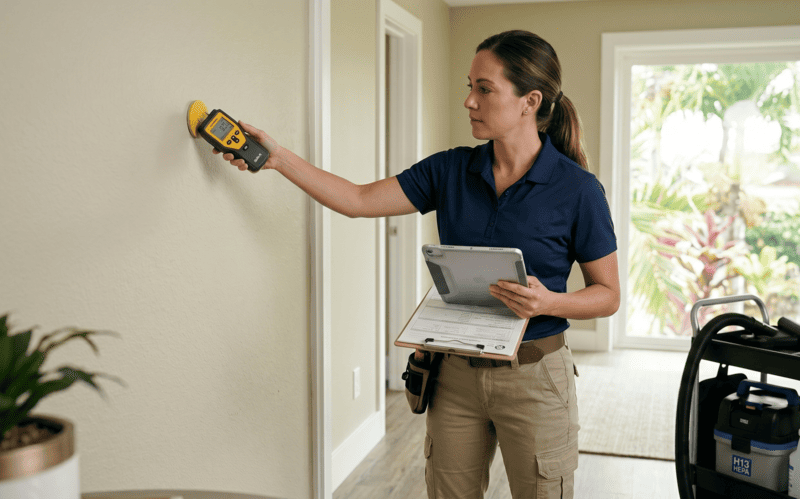
A professional assessment goes well beyond a visual walkthrough. The tools that matter most — calibrated moisture meters and thermal imaging cameras — reveal what the eye cannot see. Moisture meters measure the moisture content inside wall assemblies, flooring substrates, and ceiling materials, flagging areas where readings are elevated above acceptable baselines even when the surface feels and looks dry. Thermal imaging identifies temperature anomalies caused by moisture within building cavities — wet insulation behind drywall, water pooled above a ceiling tile, or a saturated subfloor under vinyl or tile — that would otherwise require destructive investigation to locate. Together, these tools produce a moisture map of the property that tells the full story of where water entered, how far it traveled, and what it affected.
In Honolulu’s housing stock — which includes a large number of pre-1980s single-family homes, aging mid-rise and high-rise condominiums, and post-war construction that was not built to the moisture-management standards of modern code — the findings are often more extensive than homeowners expect. A roof leak that appeared to affect only one corner of a bedroom ceiling may have saturated the top plate of the wall below and wicked moisture down into the insulation cavity over several months. A slow drip from a window frame seal may have traveled along the rough framing and pooled on top of the subfloor several feet from the window. Water that entered a Honolulu home in November and was never professionally dried has now had the full rainy season to create conditions for mold — and professional mold remediation becomes necessary when moisture has been present long enough for fungal growth to establish in structural materials. Identifying these conditions through a thorough moisture assessment is the essential first step before any spring repair or renovation project begins.
Why Spring Is the Most Important Time to Act in Honolulu
The end of Honolulu’s rainy season creates a window that is uniquely favorable for both assessment and remediation. Trade winds return, humidity drops, and the drying conditions that allow structural repairs to proceed correctly are naturally present in a way they are not during the wet months. A water-damaged wall assembly that is opened and repaired in March or April will dry properly before new materials are installed — whereas the same repair attempted in December risks trapping residual moisture behind new drywall in conditions where it cannot escape. This is why experienced restoration contractors and general contractors in Hawaii time their assessments and structural repairs to take advantage of the dry season that follows the rains.
Spring is also the most active period in Honolulu’s real estate market. Homeowners preparing to list a property for sale who discover unresolved moisture damage or mold during a buyer’s inspection face a very different negotiating position than those who identified and addressed those conditions proactively. A pre-listing water damage assessment gives sellers the opportunity to understand exactly what their property contains, address issues on their own timeline and terms, and present a clean home with documentation of any completed remediation — which is increasingly expected by informed buyers in Hawaii’s market. For landlords preparing units between tenants, a seasonal assessment is equally valuable as a tool for identifying maintenance issues before they become disputes or habitability concerns. MD Restoration’s licensed general contracting team is available to proceed directly from assessment findings into repair and renovation work, eliminating the scheduling gap that typically adds weeks to a project when assessment and construction are handled by separate companies.
Schedule Your Assessment Before Repair Season Gets Away From You
March and April are the busiest months for home repair and restoration contractors on Oahu, and scheduling fills up quickly once the dry season begins and homeowners across Honolulu start acting on the damage they have been watching accumulate since November. MD Restoration’s assessment team uses professional moisture mapping and thermal imaging to give you a complete, accurate picture of your property’s condition — and our water damage restoration specialists are equipped to move immediately from assessment into mitigation and repair when active moisture conditions are found. Whether you own a single-family home in Manoa or Kaimuki, a condominium in a Waikiki high-rise, or a commercial property anywhere on Oahu, the right time to understand what the rainy season left behind is now — before the damage progresses and before the best repair season of the year slips past. Call MD Restoration any time at (808) 528-3434 to schedule your post-rainy-season water damage assessment.

