
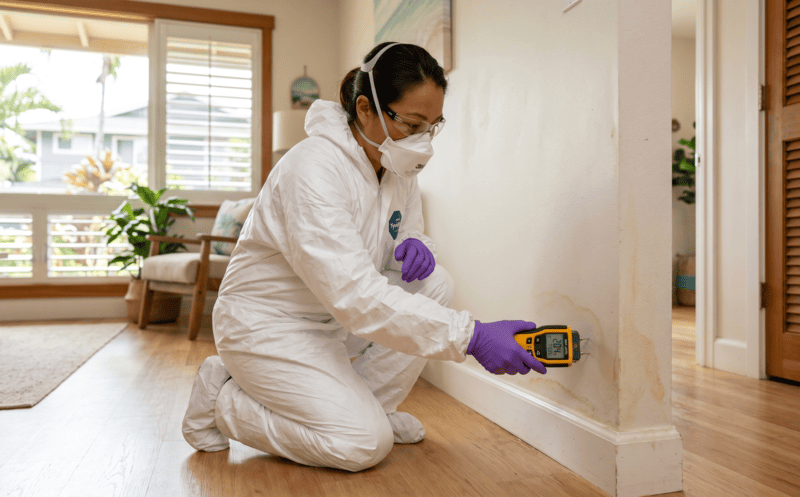
Late May in Honolulu is when homeowners start noticing things they can’t quite explain — a faint musty smell that comes and goes, a faint discoloration along a baseboard, or an allergy flare-up that started indoors rather than outside. In many cases, what they’re dealing with is hidden mold in their Honolulu home — growth that began quietly during the rainy season and has had months to establish itself in places most people never think to check.
Honolulu’s climate creates nearly ideal conditions for mold year-round, but the window from late spring through early summer is when hidden colonies are most likely to reveal themselves. The combination of residual moisture from the wet season, rising temperatures, and reduced airflow in enclosed spaces gives mold everything it needs to spread — often behind walls, under flooring, inside cabinetry, and around HVAC components where nobody is looking.
Why Honolulu Homes Are Especially Vulnerable
Hawaii’s humidity never fully disappears, but the transition out of rainy season is particularly tricky. Moisture that entered a home through a roof leak, a plumbing slow-drip, or even persistent condensation may have been absorbed into drywall, insulation, and wood framing over the course of months. That absorbed moisture doesn’t evaporate quickly — it sits, and in warm, dark spaces, mold begins growing within 24 to 48 hours of a moisture event. By late May, any growth that started in November or December has had more than enough time to expand significantly.
Oahu homes built before the 1980s are at heightened risk because older construction methods used materials and ventilation designs that are particularly susceptible to moisture retention. High-rise condominiums face a different but equally real risk from plumbing penetrations, shared walls, and laundry rooms where humidity concentrates. Even newer homes in Honolulu are not immune — modern tight construction can actually trap moisture inside the building envelope, creating the kind of dark, humid interior environment where mold thrives without any visible leak or flood event ever occurring.
The Hidden Places Mold Takes Hold
Most people picture mold as something you can see — black patches on a shower grout line or green growth on a forgotten piece of fruit. But the mold that causes serious structural damage and health concerns in Honolulu homes almost never starts somewhere visible. It begins in the places that combine moisture with darkness and limited airflow.
Under kitchen and bathroom sinks, mold frequently colonizes the interior cabinet walls and the back panel surrounding the supply lines. Inside walls adjacent to exterior-facing surfaces, condensation from Honolulu’s humid air meets the cooler temperature of the wall cavity and provides a constant moisture source. In attic spaces, inadequate ventilation allows heat and humidity to build up against the roof decking, where mold can compromise structural wood for years before it’s detected. Under flooring — particularly in bathrooms, laundry rooms, and around dishwashers — slow leaks create the sustained dampness that mold colonies require.
One of the most overlooked sources in Honolulu homes is the air conditioning system itself. When mold is present near an air handler or in the ductwork, the system actively distributes spores throughout the living space every time it runs. If you’ve noticed that musty smell intensifying when your AC kicks on, that’s worth taking seriously. Our mold remediation services include assessment of HVAC-adjacent areas precisely because of how common this pattern is on Oahu.
What the Warning Signs Actually Look Like
Because hidden mold is, by definition, out of sight, the warning signs are usually indirect. A persistent musty or earthy odor that doesn’t respond to cleaning is the most reliable indicator. Mold produces microbial volatile organic compounds as it grows, and that smell is detectable even when the colony itself is sealed inside a wall or under a floor.
Unexplained health symptoms are another important signal. If residents of a home are experiencing increased frequency of headaches, respiratory irritation, sinus congestion, or worsening asthma — particularly when spending time indoors — mold exposure should be considered as a contributing factor. These symptoms often improve noticeably when the affected person leaves the home for an extended period, which is a telling pattern.
Visual cues may eventually appear even when the primary growth is hidden: bubbling or warping paint, soft spots in drywall, staining around baseboards, and visible moisture intrusion marks around windows and doors can all indicate that conditions favorable to mold are present. If your home experienced any water damage earlier this year — a roof leak, a backed-up drain, flooding from heavy rain — and the remediation wasn’t handled by a certified professional, the likelihood of hidden mold growth is significantly elevated.
When to Call a Professional for Mold Remediation in Honolulu
The EPA guideline that homeowners can address mold patches smaller than ten square feet on their own is technically accurate, but it has important limitations. Surface cleaning removes visible growth without addressing the underlying moisture source or the mold that has penetrated into porous materials like drywall, wood, and insulation. In Honolulu’s climate, surface-only treatment almost always results in regrowth within weeks.
Professional mold remediation involves containment to prevent spore dispersal, the removal of affected materials, treatment of structural surfaces, independent post-remediation testing, and — critically — identification and correction of the moisture source. Without that last step, no remediation holds long-term. MD Restoration maintains an ACAC-Certified Indoor Environmentalist on staff in Honolulu to oversee every project, which means the assessment and the remediation are handled by specialists who are accountable to an independent certification body, not just by a crew following a checklist.
If you have reason to believe hidden mold may be present in your home — or if you simply want the peace of mind of a professional assessment after the rainy season — contact MD Restoration to schedule an inspection. Catching a problem now, before summer heat drives it further into your structure, is always the less costly and less disruptive path.

