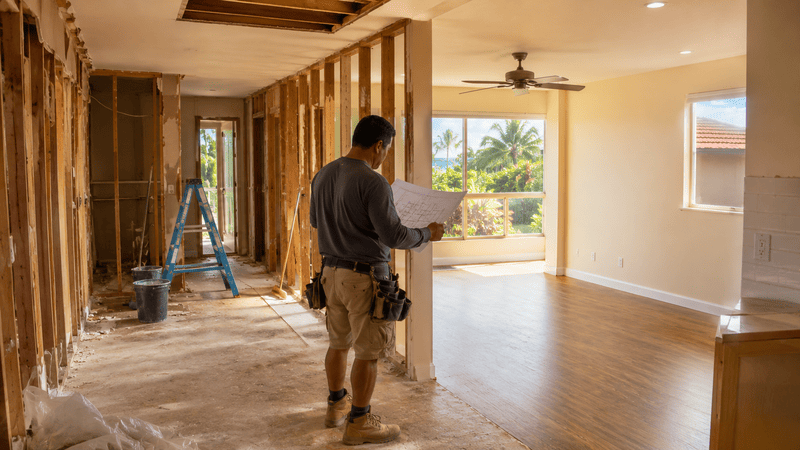
Most restoration jobs in Honolulu start the same way — a pipe fails, a storm gets in, a fire leaves smoke and structural damage — and end with drying equipment, cleanup, and a homeowner back in their space within a week or two. But a meaningful number of projects don’t stop there. Once walls are opened up, floors are pulled, or fire damage exposes framing, it becomes clear that restoration alone isn’t enough. The home needs rebuilding, not just repair. For Honolulu homeowners in that situation, the difference between a smooth process and a frustrating one usually comes down to one thing: whether their restoration company can also legally do the construction work.
Why Restoration and Rebuild Often Get Split Between Two Companies
Many restoration companies are licensed to handle mitigation — water extraction, drying, mold remediation, smoke cleanup — but not structural construction. Once a project moves past mitigation into rebuilding drywall, flooring, cabinetry, or framing, homeowners are often told to find a separate general contractor to finish the job.
That handoff sounds simple on paper, but in practice it creates real problems:
- Duplicate assessments. A second contractor has to re-evaluate the damage from scratch, often extending the timeline by days or weeks.
- Inconsistent documentation. Insurance claims move faster when one company documents the full scope of loss from start to finish. Splitting the work across two companies increases the chance of gaps or disputes in the claim.
- Scheduling gaps. Restoration and rebuild crews from different companies aren’t coordinating on the same calendar, which often means a home sits partially finished for longer than necessary.
- Unclear accountability. If something doesn’t line up between the restoration scope and the rebuild scope, homeowners are often the ones stuck untangling it.
Why Working With One Licensed Company Changes the Process
MD Restoration is both an IICRC Certified Firm and a licensed general contractor (License #BC-30852) in Hawaii, which means we’re able to manage a project from the first emergency call through the final rebuild without bringing in a second company. For Honolulu homeowners, that has a few practical effects:
One point of contact, start to finish. The same team that extracts water, removes mold, or cleans up fire damage is the team that rebuilds the affected areas — no re-explaining the situation to a new company partway through.
Faster insurance claims. A single, continuous scope of work and documentation trail tends to move through insurance adjusters more smoothly than two separate claims from two separate vendors.
No idle time between phases. Because mitigation and construction are scheduled by the same company, there’s no waiting on a second contractor’s availability once drying or demolition is complete.
Consistent quality control. The team that assessed the original damage understands exactly what needs to be addressed in the rebuild — nothing gets lost in translation between companies.
What the Process Typically Looks Like
- Emergency response and assessment. We evaluate the extent of water, fire, or mold damage and identify what can be restored versus what needs to be rebuilt.
- Mitigation. Extraction, drying, demolition of unsalvageable materials, mold remediation, or smoke and soot cleanup, depending on the type of loss.
- Scope of rebuild. Once the space is stabilized, we outline exactly what needs to be reconstructed — flooring, drywall, cabinetry, framing, or in more significant cases, full room or structural rebuilds.
- Construction. Our general contractor team completes the rebuild to code, coordinating permits and inspections as needed for the scope of work.
- Final walkthrough. The homeowner reviews the completed space before we close out the project and, where applicable, the insurance claim.
When a Rebuild Becomes Necessary
Not every restoration job needs a general contractor, but several situations commonly do:
- Flooring that’s been saturated long enough to warp, delaminate, or grow mold underneath
- Drywall and framing exposed to fire, smoke, or prolonged water intrusion
- Cabinetry or built-ins damaged beyond salvage in a kitchen or bathroom
- Structural repairs following significant water, fire, or storm events
- Full room reconstructions after major loss events
MD Restoration: Mitigation and Rebuild Under One Roof
If your Honolulu home has damage that’s moved past cleanup and into rebuild territory, you don’t need to manage two separate companies to get it done right. MD Restoration handles both phases of the project, from the first emergency call to the final walkthrough. Call us 24 hours a day, 7 days a week at (808) 528-3434, or visit our contact page to get started.

