Water damage in a commercial property operates on a completely different scale than water damage in a home. When a pipe fails overnight in a Honolulu office building, a restaurant kitchen, a retail storefront, or a hotel corridor, the water doesn’t wait for business hours — and neither does the damage. By the time staff arrives in the morning, what might have been a manageable extraction and drying job has become a multi-room saturation event with soaked inventory, compromised flooring, damaged ceilings, and the early conditions for mold growth already established in wall cavities and subfloor assemblies. Commercial water damage restoration in Honolulu requires a response capability, a workforce, and an equipment inventory that is simply not the same as residential restoration — and choosing a contractor who understands the commercial difference is one of the most important decisions a property owner or facilities manager will make in a crisis.
How Commercial Water Damage Differs From Residential
The physical differences between a commercial water loss and a residential one begin with scale. A single-story office suite or restaurant can encompass thousands of square feet of affected area from a single pipe failure, with water migrating under raised flooring systems, into server rooms, through drop ceiling assemblies, and across multiple tenant spaces simultaneously. Multi-story commercial buildings present additional complexity — water moving vertically through a structure affects multiple floors and multiple tenants, each with their own lease terms, contents, and business interruption concerns. The materials involved in commercial construction — concrete, steel framing, commercial-grade flooring systems, drop ceilings, and mechanical rooms — require different drying approaches and longer drying timelines than the wood-frame residential construction that most restoration contractors are primarily equipped to handle.
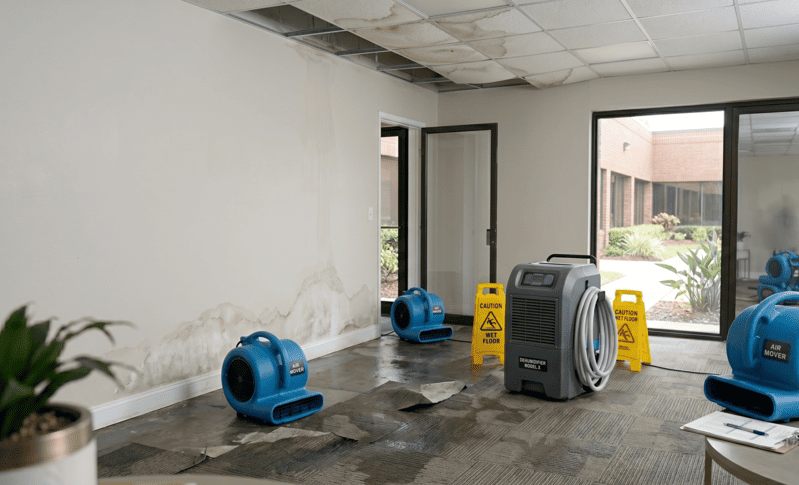
Business interruption is the factor that creates the most acute pressure in commercial water damage scenarios. Every hour a restaurant cannot seat guests, a retail store cannot open its doors, or an office cannot function is direct revenue loss and reputational exposure — and in Honolulu’s competitive hospitality and tourism-driven economy, that exposure can be significant. The speed of the initial response determines how much of that business interruption is avoidable. MD Restoration’s 24/7 emergency water extraction team is equipped and staffed to respond to commercial losses at any hour, with the high-capacity extraction equipment, industrial drying arrays, and certified technician teams that large-scale commercial water events demand. Arriving within hours rather than the next business day is not just better service — in a commercial context, it is often the difference between a business that reopens in days and one that is closed for weeks.
Mold Risk in Honolulu’s Commercial Buildings
Honolulu’s warm, humid climate makes commercial buildings on Oahu particularly susceptible to rapid mold development following a water event. Commercial construction materials — drywall, acoustic ceiling tiles, carpet tiles, and the insulation within wall and ceiling assemblies — are as susceptible to mold colonization as residential materials, and in many cases more so because commercial buildings have larger quantities of organic material distributed across greater areas. The timeline from water intrusion to active mold growth in Honolulu’s climate is the same as in a residence — 24 to 48 hours under favorable conditions — but the scale of potential contamination in a commercial building is vastly larger. A water loss that is not fully extracted and dried within that window creates a mold scenario that requires professional remediation across potentially thousands of square feet of affected material.
For commercial property owners and managers in Honolulu, the most costly mistake following a water event is allowing surface drying to substitute for professional structural drying. Commercial spaces that appear dry — with flooring surfaces and visible wall areas that feel and look normal — routinely contain significantly elevated moisture levels inside wall assemblies, above drop ceilings, and beneath flooring systems that will produce mold growth within days if not addressed with professional equipment and moisture mapping. MD Restoration’s commercial mold remediation capabilities include the containment protocols, air filtration, and remediation sequencing required to address mold in occupied or partially occupied commercial buildings without shutting down unaffected areas of the property unnecessarily.
From Emergency Response to Full Commercial Rebuild
What distinguishes MD Restoration’s commercial restoration capability on Oahu is the ability to take a commercial water loss from the initial emergency response all the way through the finished rebuild under a single licensed contractor. The extraction and drying phase stabilizes the property and stops active damage progression. The assessment phase — using thermal imaging and calibrated moisture mapping — documents the full scope of saturation for insurance purposes and identifies every area requiring remediation or repair. The rebuild phase, managed by MD Restoration’s licensed general contracting team, replaces damaged drywall, ceiling systems, flooring, and finishes and returns the commercial space to operational condition. For business owners and property managers, working with a single contractor across all three phases eliminates the scheduling gaps, documentation gaps, and accountability gaps that arise when emergency response, remediation, and reconstruction are handled by separate companies — and it produces a unified insurance documentation package that supports the claim from first response through final completion. If your Honolulu commercial property has experienced water damage, or if you are a property manager preparing for hurricane season and want to assess your building’s water intrusion vulnerabilities before June 1, call MD Restoration any time at (808) 528-3434.

