January is when many Honolulu homeowners finally commit to the renovation projects they’ve been planning for months — a bathroom remodel, new flooring throughout the house, a kitchen update, or opening up a wall to improve a floor plan. What often gets overlooked in that excitement is a question that matters enormously in Hawaii’s older housing stock: does the home contain asbestos? Asbestos testing in Honolulu is not just a precaution for older buildings — for any home or condominium constructed before the mid-1980s, it is a necessary first step before any renovation work that disturbs walls, ceilings, flooring, or pipe insulation begins. Skipping that step doesn’t just create a health risk. In Hawaii, disturbing asbestos-containing materials without proper testing, notification, and licensed abatement is a regulatory violation that can result in significant fines and project shutdowns.
Why Honolulu’s Housing Stock Carries Elevated Asbestos Risk
Asbestos use in building materials was banned by the U.S. government in 1978, but construction using materials manufactured before the ban continued well into the mid-1980s. In Honolulu, that means a large portion of the existing housing stock — particularly the condominium towers built along the Ala Wai and in Waikiki during the 1960s and 1970s, the single-family homes in established neighborhoods like Manoa, Kaimuki, Nuuanu, and Palolo, and the commercial buildings throughout downtown Honolulu — may contain asbestos in one or more building materials. The challenge is that asbestos is not visually identifiable. It was used in an extraordinarily wide range of products: floor tile and the adhesive beneath it, popcorn and textured ceiling coatings, drywall joint compound, pipe and duct insulation, roofing felt, window glazing, and the insulation surrounding boilers and hot water systems. A home can appear completely modern and updated on the surface while still containing asbestos in original materials that were never removed during previous renovations.
Asbestos fibers become hazardous when the materials containing them are disturbed — cut, sanded, drilled, broken, or demolished — releasing microscopic fibers into the air that can be inhaled and lodge permanently in lung tissue. In undisturbed, intact condition, many asbestos-containing materials pose minimal immediate risk. But the moment a renovation crew begins removing old floor tile, sanding popcorn ceilings, or cutting into original drywall in a pre-1986 Honolulu home, the risk profile changes entirely. This is why professional testing before any work begins is so important — not after a problem is suspected, but as a standard part of the project planning process. MD Restoration’s licensed asbestos abatement and testing team provides the sampling, laboratory analysis, and project planning that homeowners and property managers need before renovation work proceeds.
What the Testing and Abatement Process Involves
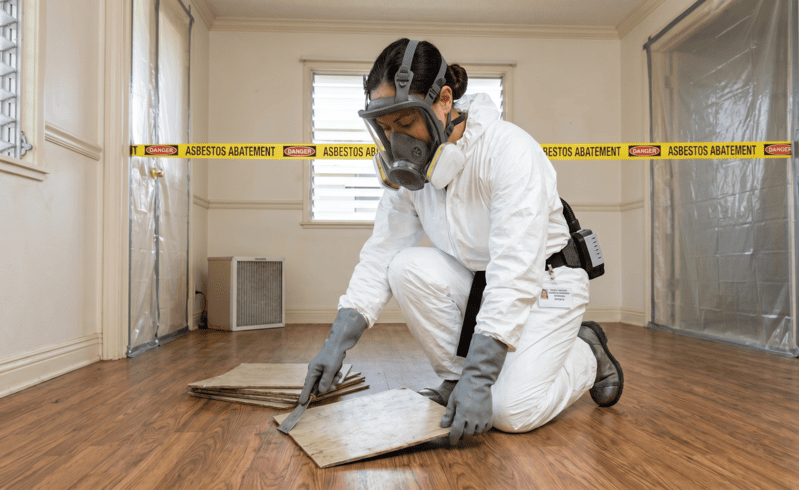
Professional asbestos testing begins with a visual inspection and the collection of material samples from any building components that may contain asbestos and are likely to be disturbed by the planned renovation. Samples are sent to an accredited laboratory for analysis, and results typically confirm whether asbestos-containing materials are present and at what concentration. If testing confirms the presence of asbestos, the abatement process — the safe removal, containment, and disposal of those materials — must be performed by a licensed contractor before any other renovation work can proceed. In Hawaii, asbestos abatement is regulated by the Hawaii Department of Health, and the work must be performed under strict protocols: containment of the work area, use of appropriate protective equipment, wet methods to suppress fiber release during removal, and disposal at approved sites.
What distinguishes MD Restoration’s approach is that asbestos abatement does not have to be a standalone project that delays or complicates your renovation timeline. As a licensed general contractor as well as a licensed asbestos abatement firm, MD Restoration can manage the testing, abatement, and post-abatement reconstruction as a single coordinated project. Once hazardous materials have been safely removed and the work area cleared, our general contracting team can proceed directly with the renovation work — eliminating the need to coordinate multiple separate contractors and the scheduling gaps that typically add weeks to a project timeline.
Starting Your 2026 Renovation the Right Way
If you are planning a renovation in a Honolulu home or commercial property built before 1986, the most important investment you can make before the first tool is picked up is a professional asbestos assessment. It protects your family, your contractors, your neighbors, and your renovation budget from the disruption and cost of an unplanned abatement mid-project. It also ensures compliance with Hawaii’s regulations from day one, which matters particularly for condominium projects where building management and neighboring units have a direct interest in how hazardous materials are handled. MD Restoration has been serving Honolulu and Oahu property owners since 2002, and asbestos abatement is one of our core licensed specialties. If you experienced any water damage over the past few months that affected original building materials — ceiling tiles, floor tile, pipe insulation — it is also worth noting that emergency water damage events can disturb asbestos-containing materials in ways that require assessment even outside of a planned renovation. To schedule asbestos testing or to discuss an upcoming project, call MD Restoration any time at (808) 528-3434.

