
Spring is the busiest season in Honolulu’s real estate market, and for buyers and sellers transacting in Oahu’s older housing stock, asbestos is one of the most common — and most misunderstood — complications that can arise between offer acceptance and closing. Asbestos abatement in Honolulu is not a rare or unusual requirement. Given that structures built throughout Hawaii up until the mid-1980s may have incorporated asbestos-containing materials, and given that a substantial portion of Honolulu’s condominium inventory and single-family housing stock falls within that construction window, asbestos discoveries during the inspection period are a routine part of real estate transactions on Oahu. What determines whether that discovery derails a transaction or gets resolved efficiently is almost entirely a function of how quickly professional testing and abatement is engaged — and how experienced the abatement contractor is at working within the timelines and documentation requirements that real estate transactions demand.
What Triggers Asbestos Concerns in a Real Estate Transaction
Asbestos-related issues in Honolulu real estate transactions typically surface in one of three ways. The most common is a home inspection report that flags suspect materials — textured ceiling coatings, resilient floor tile and its adhesive, pipe insulation, or drywall joint compound — and recommends asbestos testing before the transaction proceeds. The second is a seller disclosure that acknowledges known asbestos-containing materials in the property, which may prompt a buyer to request testing and abatement as a condition of closing. The third — and most disruptive — is a renovation or repair performed during escrow that inadvertently disturbs suspected materials, triggering a regulatory obligation to test and, if asbestos is confirmed, remediate before work can continue or the property can transfer.
In all three scenarios, the critical variable is time. Real estate inspection contingency periods in Hawaii are typically short, and closing dates represent significant financial obligations for both parties. An asbestos discovery that would be manageable with a few weeks of lead time can become a transaction-threatening problem if testing, abatement scheduling, regulatory notification, and clearance testing all need to happen within a compressed window. MD Restoration’s licensed asbestos abatement and testing team works regularly with real estate attorneys, escrow officers, buyers’ agents, and sellers’ agents throughout Honolulu specifically because we understand that timeline pressure — and because our ability to move from testing through abatement through clearance documentation under one licensed contractor eliminates the coordination delays that occur when those phases are handled by separate firms.
What the Abatement Process Looks Like on a Real Estate Timeline
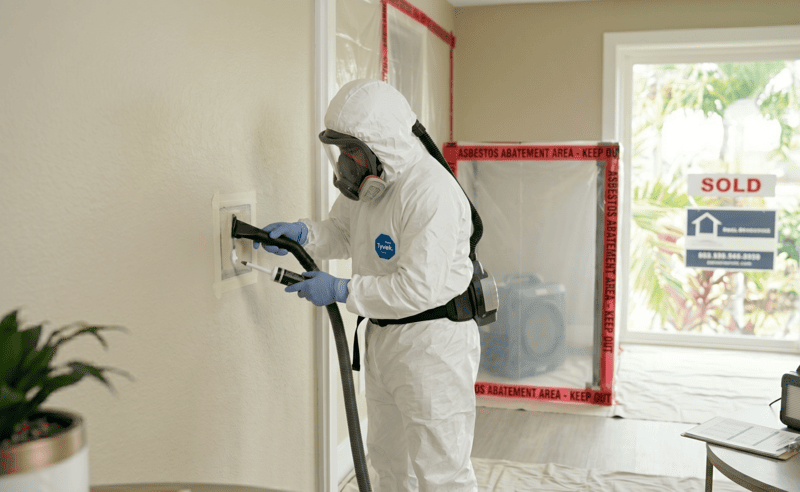
When asbestos testing confirms the presence of asbestos-containing materials in a Honolulu property, the abatement process follows a regulated sequence that must be completed correctly to produce the clearance documentation that escrow requires. The Hawaii Department of Health requires notification before abatement work begins, and the abatement itself must be performed by a licensed contractor using prescribed containment and removal protocols — wet methods to suppress fiber release, negative air pressure in the work area, appropriate personal protective equipment, and disposal at approved sites. Once abatement is complete, a clearance inspection and air testing confirm that fiber levels in the work area have returned to acceptable levels, producing the documentation that satisfies escrow and protects all parties in the transaction.
For sellers, proactive asbestos testing before listing is increasingly the preferred approach in Honolulu’s market, particularly for properties built before 1980. Knowing what a property contains — and having completed abatement with documentation in hand — removes one of the most common sources of inspection-period renegotiation and gives buyers confidence that the property has been professionally evaluated and cleared. For buyers, understanding that an asbestos finding is a solvable problem rather than a transaction-ender is important context. The cost and timeline of professional abatement are predictable, and in many transactions the cost is negotiated as a seller credit or completed as a condition of closing without material impact on the agreed price. MD Restoration’s licensed general contracting team can also handle any post-abatement repairs — replacing removed flooring, restoring ceiling finishes, or completing any renovation work that the abatement made possible — so that the property is in move-in condition at closing rather than mid-project.
The Asbestos and Water Damage Connection in Older Honolulu Homes
One scenario that arises more often than buyers and sellers expect is the intersection of asbestos-containing materials and water damage in older Honolulu properties. A property that has experienced water intrusion from a roof leak, plumbing failure, or storm event may have damaged or disturbed asbestos-containing materials — saturated floor tile, wet pipe insulation, or compromised ceiling texture — in ways that create both a water remediation need and an asbestos abatement requirement simultaneously. When that condition is discovered during a real estate inspection, addressing it requires a contractor who is licensed and equipped to handle both. MD Restoration’s certifications in both water damage restoration and asbestos abatement mean that a combined water and asbestos loss in a Honolulu property can be assessed and remediated under a single project scope, with unified documentation for escrow, rather than requiring separate contractors to coordinate on a shared timeline. If a property you are buying or selling in Honolulu has raised asbestos concerns — whether through an inspection report, a seller disclosure, or a recent water event — call MD Restoration any time at (808) 528-3434. We are here to help you move through the process efficiently and get to closing on schedule.

